TRANSMIXR
eXtended Reality (XR) plays a big role in sectors like gaming, health care and education, allowing for immersive experiences. How can the cultural and creative industries benefit from immersive technologies as well? Within the project TRANSMIXR (2023 - 2025), we investigated opportunities, challenges and barriers for meaningful use of XR within our sector, aiming to increase accessibility by creating standardized workflows and reusable templates for immersive experiences.


eXtended Reality (XR) plays a big role in sectors like gaming, health care and education, allowing for immersive experiences. How can the cultural and creative industries benefit from immersive technologies as well? Within the project TRANSMIXR (2023 - 2025), we investigated opportunities, challenges and barriers for meaningful use of XR within our sector, aiming to increase accessibility by creating standardized workflows and reusable templates for immersive experiences.
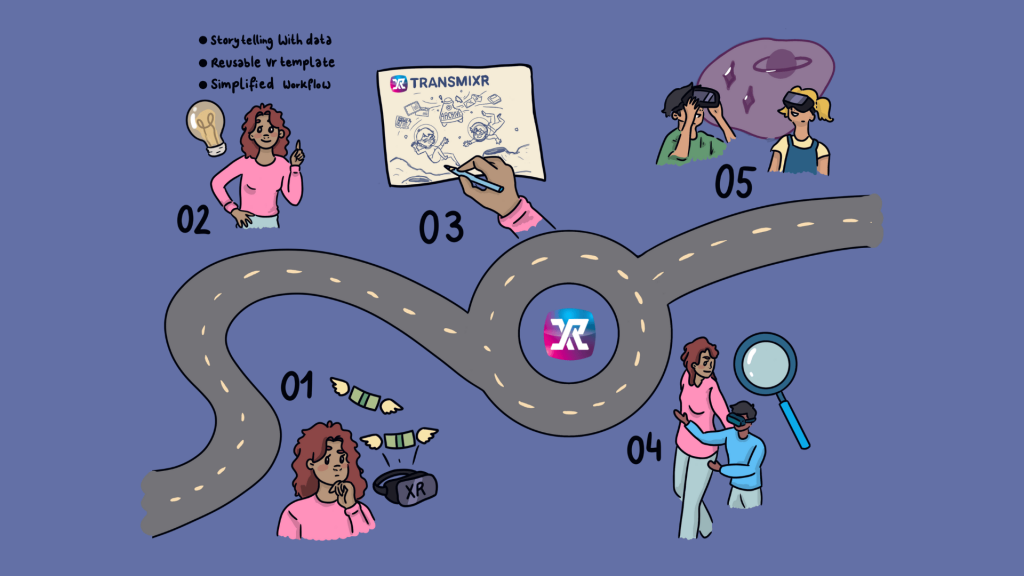

Image: XR makes it possible to experience cultural heritage in an immersive way.
What is eXtended Reality?
There are various immersive technologies that stimulate our senses in their own unique ways, such as Virtual Reality (VR), Augmented Reality (AR), and Mixed Reality (MR). XR is a term that encompasses all of these immersive technologies. As XR continues to evolve, more and more becomes possible, creating many opportunities - but also equally exciting challenges.
Within TRANSMIXR, we investigated how XR could be used to create meaningful interactions within three domains: cultural heritage, performing arts, and news broadcasting.

Image: An example of a VR game in which the player learns more about the history of music using archive material.
Challenges
Sound & Vision of course focussed on how to integrate XR within the domain of cultural heritage. Through our research, we discovered that XR adoption in the cultural heritage field faces several challenges that prevent wide-scale integration:
- High investments: XR experiences are usually one-off installations that require significant financial resources, including the costs of developing content.
- Access to high-quality 3D assets: Digital 3D assets of heritage objects are seen as essential for XR experiences, but creating these is both time-consuming and costly.
- Identifying meaningful application areas: Designing experiences with engagement opportunities that go beyond what non-XR methods can achieve is not an easy task.

Image: Archives are often full of wonderful items that visitors don't see. XR makes it possible to discover hidden collections.
Solutions
To lower or remove the above barriers, we came up with the following solutions within the project:
- Reusable immersive storytelling format: Our interaction templates in VR can be iteratively updated with new data and content. Cost-effective and sustainable.
- Storytelling with rich collection metadata: Since 3D assets are costly, we designed game formats to animate existing digitised (2D) collections and their metadata in immersive environments.
- Social VR: Visitors use social VR to interact in real-time within the same virtual space, creating meaningful shared learning and collaboration moments.
Through these innovations, TRANSMIXR is paving the way for a new era of immersive storytelling—one that is inclusive, sustainable, and adaptable.
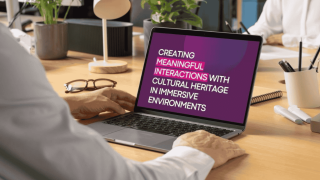
These solutions are explained in more detail in the guide Creating Meaningful Interactions with Cultural Heritage in Immersive Environments, made by Sound & Vision for the TRANSMIXR project.
Role of Sound & Vision: Meaningful interactions with cultural heritage
Imagine stepping into the hidden depot of a museum collection: aisles of cupboards and boxes, yellowed name tags assigning years to objects, the faint, stale scent of time past. Each object holds a story, but what remains of these stories if no one sees them?
With the cultural heritage use case of TRANSMIXR, our goal was to change that. Over the course of three years, we imagined ways to experience cultural heritage without the physical limits of a museum or an archive – in a playful way. We aimed to expand the sector’s ideas of what exhibitions are and how curation works, embracing interactivity and engaging storytelling in XR.
How? Together with our partners Khora and CWI, we built the brand-new Social VR Game The Space Archivists, we created various useful resources and hosted several capacity building workshops, training courses, and presentations within the sector.

Trailer: In the social VR game The Space Archivists, players can explore the archive.
The Space Archivists
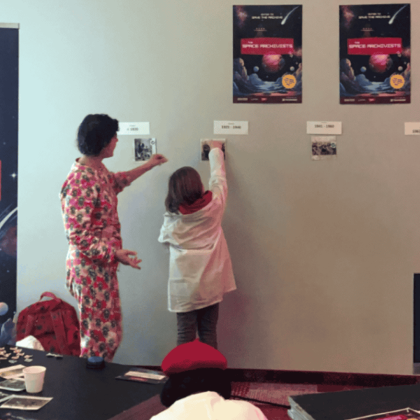
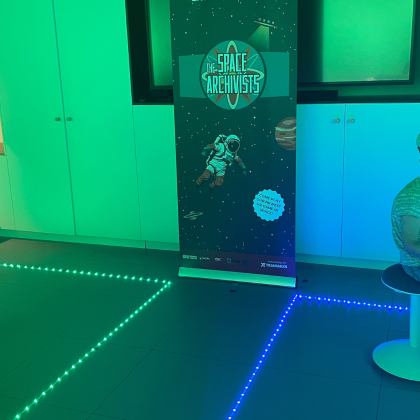
Together with project partners Khora and CWI, Sound & Vision developed the VR installation The Space Archivists. The Space Archivists is a multiplayer game in Virtual Reality that allows players to interact with each other and with cultural heritage. The setting: In a futuristic sci-fi scenario, an archive has been sent into space to safeguard humanity's memories. An unexpected meteor storm has scattered all the objects in the archive. It is up to the players to repair the archive by putting all the items back in their places.
The game can be designed with new content via the curator interface. Here, curators from museums, archives, and other cultural heritage institutions can enter datasets that allow them to easily create new themes for the game.
Past Events
-

Design Salons 2023-2025
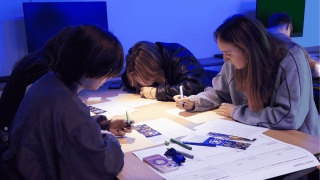
To better understand how XR can provide value to both professional curators in cultural heritage institutions as well as visitors who experience these technologies, a series of design salons was organised from 2023 to 2025. These workshops brought together curators, researchers, and other stakeholders in order to create a workflow and reusable template suitable for the sector.
-

Workshop: Beyond Virtual Museums 2024
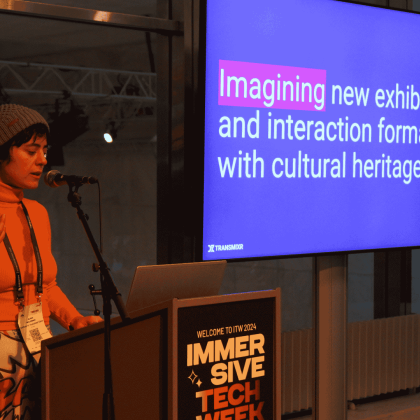
In the Beyond Virtual Museums workshop, we challenged participants to come up with new forms of exhibition and interaction with cultural heritage that go beyond the popular virtual museum concept. The aim of the workshop was to give free rein to the imagination and explore the possibilities of XR in a creative way. Of course, during the workshop we also considered the barriers that prevent institutions from using XR.
-

Cinekid Medialab 2024
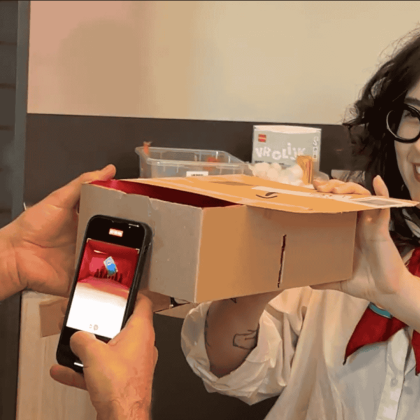
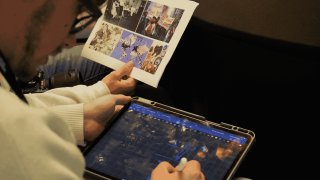
You don't just make a VR game overnight — the end result is preceded by many prototypes and hours of testing. In the fall of 2024, TRANSMIXR was featured in Cinekid's Medialab, where a group of enthusiastic children played a paper prototype of The Space Archivists! This allowed us to test the game mechanics and make adjustments where necessary.
-

Cinekid Medialab + Industry Forum 2025
After several rounds of development and extensive testing, the game The Space Archivists is now complete and has been selected for Cinekid Medialab 2025. A true milestone! From October 11 to 24, 2025, the game was available to visit and play at Pathé Noord in Amsterdam. In addition, the TRANSMIXR team was present at the Cinekid Professionals Program on October 21, 2025, for a roundtable discussion.

Partners
For the cultural heritage use case, Sound & Vision works together with Centrum Wiskunde & Informatica (CWI), Khora, the Vrije Universiteit Brussel (VUB) and the Technological University of the Shannon: Midlands Midwest (TUS).
All of TRANSMIXR’s consortium partners:
TUS Midlands Midwest, CWI, VUB, Modul Technology, HSLU, CERTH, Trinity College Dublin, Intel, VRAI, Story Pact, Khora, Web Lyzard Technology, Immersion, F6S, TG4, AFP, RTV SLO, Baltic Film & Creative Tech Cluster, Sound & Vision, Spark, Satore Studio, EBU.
This project has been funded by the European Union as part of the Horizon Europe Framework Program (HORIZON), under the grant agreement 101070109.

Want to know more?
Contact our colleagues listed at the top of this page.
No contacts visible above?